
How Accurate Are AI Calorie Apps? What the NIH Found When It Weighed the Food
NIH researchers weighed 102 meals to a tenth of a gram and compared them against four popular calorie apps. Measured one by one, the apps ran between roughly 250 and 345 calories short per meal. Here's why photo tracking misses, and how to correct for it.
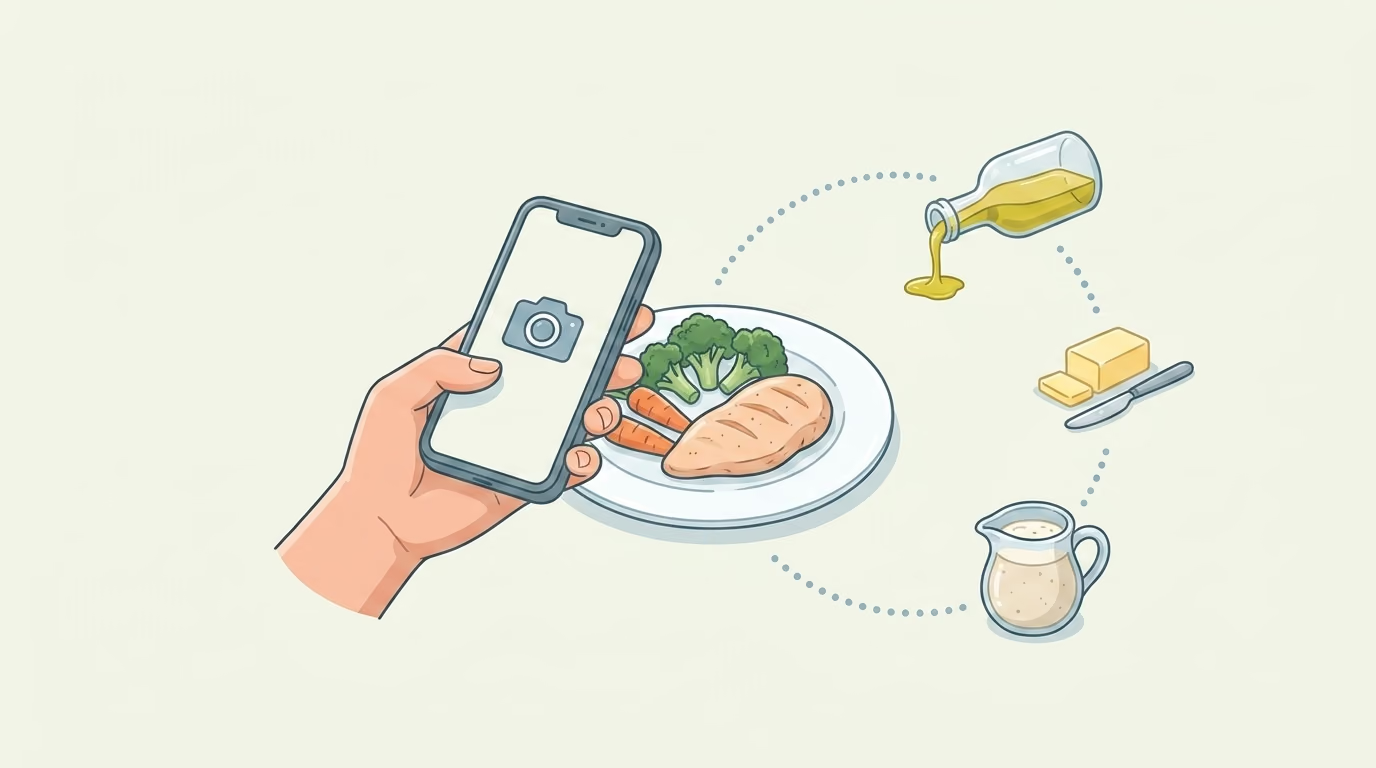
Researchers at the National Institutes of Health cooked meals in a metabolic kitchen, weighed every ingredient to the nearest tenth of a gram, photographed each plate, and ran the photos through four photo-based calorie apps. Every app came in low. Measured one by one, they ran between roughly 250 and 345 calories short per meal — around a third of the meal — and about 30 grams of fat short.
If a gap that size repeated across three meals, it would be somewhere between 750 and 1,000 calories a day eaten but never logged. That is larger than the deficit most people are trying to create in the first place.
Source: Olivia Charles and Aaron Hengist, National Institute of Diabetes and Digestive and Kidney Diseases, presented at NUTRITION 2026, American Society for Nutrition, National Harbor, Maryland, July 25 2026. Conference abstract — not yet peer reviewed.
What the study actually did
The work comes from Olivia Charles and Aaron Hengist at the National Institute of Diabetes and Digestive and Kidney Diseases, presented at NUTRITION 2026, the American Society for Nutrition’s annual meeting, in National Harbor, Maryland on July 25 2026. The team started with 102 controlled-feeding meals and extended the analysis to more than 200 additional meals. Because the meals were prepared for a clinical trial, every component was weighed to 0.1 g before it reached the plate — so unlike almost every accuracy claim on the internet, there was a true reference value to compare against.
The apps tested were MyFitnessPal, Lose It!, Cal AI and Appediet, and the abstract reports each one separately: MyFitnessPal 327 calories light per meal (95% CI 269 to 385), Lose It! 333 (282 to 383), Cal AI 345 (296 to 392) and Appediet 252 (210 to 295). Those intervals overlap across most of their range, so the result does not establish that any one app is better or worse than another. The 250-to-345 span is four individual results, not an average across the group.
One caveat, stated plainly
These findings were presented as a conference abstract. Abstracts at NUTRITION 2026 are reviewed and selected by a committee of experts, but they have generally not completed the full peer review process required for publication in a scientific journal. That is a real limitation, and you should weigh it accordingly — including against the peer-reviewed study in the next section, which reached a very different-looking conclusion.
Why one study says MyFitnessPal is the most accurate app and another says it is 327 calories light
In 2024, a team publishing in Nutrients ran the most detailed published head-to-head comparison of AI food-image apps: 18 nutrition apps, seven of them with image recognition, tested on 22 images containing 39 separate food components. MyFitnessPal identified 97 percent of components and landed within 3 percent on energy. On that evidence, photo tracking looks close to solved. Every app was tested at its early-2024 version, and all of them have shipped model updates since.
View the data as a table
| App | Components identified | Mean energy difference |
|---|---|---|
| Foodvisor | 87% | -47% |
| MyFitnessPal | 97% | -3% |
| HealthifyMe | 90% | +8% |
| Fastic | 92% | +44% |
| HitMeal | 62% | Not reported |
| Lose It! | 46% | Not reported |
| FatSecret | 46% | Not reported |
Source: Li X, Yin A, Choi HY, Chan V, Allman-Farinelli M, Chen J. Nutrients 2024;16(15):2573.
Look closely at that chart and the real story appears. Fastic identified 92 percent of components and still came out 44 percent high on energy. Foodvisor identified 87 percent and came out 47 percent low. Two apps that are almost equally good at naming the food land nearly a hundred percentage points apart on counting it.
Identifying the food is the easy half. The calories live in the half a photograph cannot show you.
That is also what reconciles the two studies, though not in the way you might expect. Both compared app output against food-composition-database values for precisely weighed food, so the reference standard is not the difference. What differs is the plate. The 2024 paper’s headline energy figures come from single-component items photographed under controlled conditions — one food, good light, a fixed angle. Its mixed-dish results were far worse. The 2026 meals were complete plates from a ketogenic-versus-standard-diet trial, averaging over 900 calories, which is exactly where the apps’ blind spot for fat does the most damage.
What a camera physically cannot see
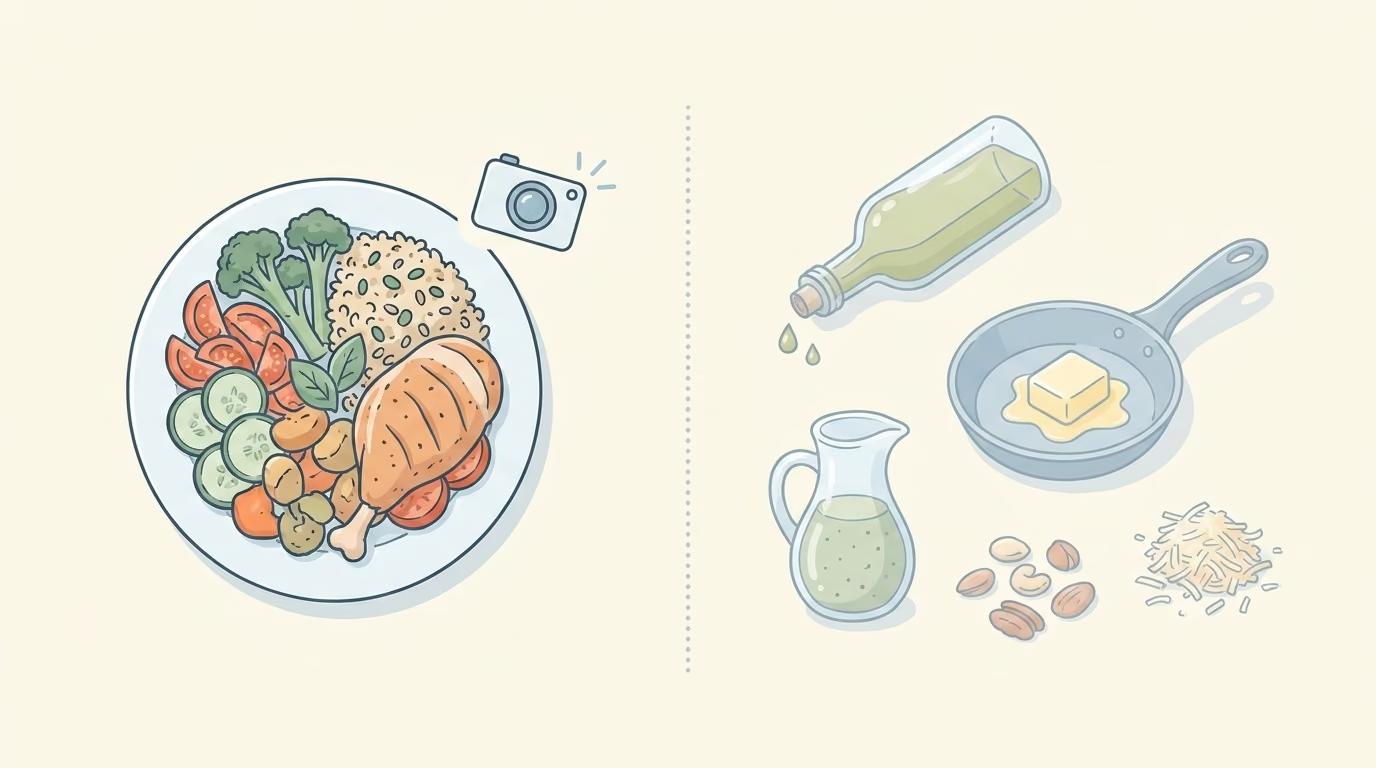
The oil in the pan
The Nutrients authors identified this directly: image recognition cannot detect ingredients added during cooking — butter, oils, salt. A single tablespoon of olive oil is about 119 calories and roughly 14 grams of fat, and once it is absorbed into a chicken thigh or a pan of vegetables it is invisible. Two or three tablespoons across a day of home cooking is 240 to 360 calories that no camera will ever recover. Cooking fat is one plausible part of the NIH team’s roughly 30-gram fat shortfall, but it is not the explanation the researchers reach for: those meals came from a ketogenic-versus-standard-diet study and were high in fat to begin with, and the coverage points at that fat content itself as the likely driver.
Depth
A photograph is two-dimensional and food is not. From a single frame, the model infers how deep the bowl is, how densely the rice is packed, and how thick the cut of meat is. Those inferences are a major remaining source of error, and they degrade fastest on exactly the foods people eat most: piled, stacked, and served in vessels of unknown depth.
Mixed dishes
The 2024 study found the sharpest failures in dishes where components are combined rather than plated separately — the model can see a curry, but not the four tablespoons of coconut cream inside it. Pearl milk tea was underestimated by as much as 76 percent — and the errors ran both ways, with one app coming out 270 percent high on bibimbap.
What is on the menu where you live
The same paper found that accuracy dropped on culturally diverse cuisines, with mixed and Asian dishes proving hardest. This is a training-data problem rather than a physics problem, but it has a practical consequence: that paper tested Western and Asian diets side by side and the Asian dishes fared worse, so your own results may not match a headline number if that is not the food you eat.
Every one of those failure modes is about how much, not what. That distinction is the whole basis of the correction protocol below.
So can you trust an AI calorie counter?
Trust the direction, not the decimal. The critical property of this error is that it is systematic rather than random — the apps miss the same things in the same direction, meal after meal. A tracker that is consistently 300 calories light still tells you, accurately, that Saturday was heavier than Tuesday and that this week ran higher than last. What it cannot do is tell you that you ate 1,847 calories.
The practical translation: calibrate against yourself. Log consistently for two to three weeks, track your actual weight trend, and set your target from what happened rather than from the app’s arithmetic. If the scale is flat while the app says you are 500 calories under, start from your own trend rather than the app’s arithmetic — you now know your personal offset.
Which is more accurate, Cal AI or MyFitnessPal?
The 2026 NIH work measured both, and the honest answer is that it does not separate them. MyFitnessPal came out 327 calories light per meal and Cal AI 345, with confidence intervals that overlap across most of their range — on 102 meals, a gap that size is not a ranking. The peer-reviewed 2024 comparison included MyFitnessPal, where it led on the measures it reported, but did not include Cal AI at all.
You will also find very specific-sounding accuracy percentages circulating for these apps. We could not trace them to any published study or stated method, so we have not repeated them here. A useful test you can apply to any comparison, including this one: does it name what the estimates were measured against? If it does not, it is not telling you anything about accuracy.
How to make photo tracking accurate enough to actually work
The error is predictable, which means it is correctable. Five habits close most of the gap, and the first one closes more of it than the other four combined.
- Log the fat you cook with, separatelyBefore you photograph anything, log the oil, butter, or dressing by volume — “one tablespoon olive oil” as its own entry. This is the single highest-value habit in the entire list, because it is the largest error the camera cannot reach.
- Weigh five things, ignore the restOils, nuts, nut butters, cheese, and dressings carry most of the calorie density and most of the estimation error. Weighing broccoli changes nothing. A scale used on five foods gets you the majority of the benefit of weighing everything, at a fraction of the effort.
- Shoot before you mixPhotograph components while they are still visually separate, and from a slight angle rather than directly overhead so the model has some depth information to work with. Once it is stirred together, the estimate degrades in exactly the way the mixed-dish research predicts.
- Pick one app and stay in itSystematic error only cancels out if it stays constant. Switching apps mid-goal resets your offset and makes your own history uncomparable, which costs you more accuracy than any difference between the apps themselves.
- Judge the week, not the mealA single meal estimate carries the full error. Seven days of estimates carry the same bias but far less noise, and the trend is what you can actually act on.
Tavita tells you up front that the camera cannot see the oil in the pan, and every logged item stays editable so you can add it yourself. See how it logs a meal.
The part photo tracking genuinely does better
There is one thing photo logging does that weighing your food does not, and it gets almost no attention because it is not what people download these apps for.
Nobody weighs their dinner to find out they have been low on magnesium for six months. Calories you can feel your way toward — the scale eventually tells you the truth. Micronutrient gaps are silent, they accumulate, and they are invisible to the bathroom scale and to the calorie total alike. A log that captures what foods you ate, even with an imperfect portion estimate, is enough to reveal that you have not had a meaningful source of potassium in a fortnight, or that your magnesium intake has been running at half the reference amount.
One caveat, and it is a real one: the same Nutrients paper found app micronutrient output unreliable in absolute terms, with one app reporting sodium density more than 30-fold high and calcium faring poorly across all three diets it tested. So this works for the pattern, not the number — whether a nutrient-dense food showed up in your week at all, rather than what percentage of a target you hit. You can browse the full nutrient reference library to see what those targets actually are.
Where Tavita stands on this
Tavita is a photo-based tracker. The physics described above applies to us exactly as much as it applies to everyone else, and it would be dishonest to publish this article and imply otherwise.
What we do about it: we treat the calorie number as an estimate rather than a measurement, we warn before your first scan that the camera cannot see cooking oil or added sugar and keep every item editable, and we put most of the product’s weight behind micronutrients and supplement timing — the questions where an estimated portion is still a useful answer. Our methodology page sets out where our numbers come from and where they stop being reliable, and our supplement stack checker works on doses you enter and known interactions, not on anything a camera guessed.
If an app tells you it is 95 percent accurate from a photograph, ask what it was measured against. That question is the whole article.
Common questions
Is the Cal AI calorie tracker accurate?
One figure exists. In the 2026 NIDDK conference abstract, Cal AI's mean shortfall was 345 calories per meal (95% CI 296 to 392) across 102 meals weighed in a metabolic kitchen. That was the largest of the four apps tested, but the confidence intervals overlap the other three across most of their range, so the study does not establish that Cal AI is worse than MyFitnessPal, Lose It! or Appediet. Cal AI was not included in the 2024 peer-reviewed comparison. Those are the only published accuracy figures for it we could find; percentages circulating elsewhere are not traceable to a stated method.
Can you trust an AI calorie counter?
Trust the direction, not the decimal. The error in these apps is largely systematic — they miss the same things every time, mostly cooking fats and portion volume — which means the week-over-week trend stays useful even when the daily total is low. What you cannot do is treat the number as a measurement.
How accurate are calorie tracking apps in general?
It depends entirely on what they are measured against. Compared with database values for single-component foods photographed under controlled conditions, the best app matched within 3 percent. Compared with complete cooked meals weighed to a tenth of a gram, four apps ran between roughly 250 and 345 calories light per meal, each measured separately. Both numbers are real; they answer different questions.
Which AI calorie scan app is the most accurate?
On the main peer-reviewed head-to-head comparison available, MyFitnessPal led on both measures the study reported — 97 percent of food components identified, and the smallest mean energy difference, −3 percent, among the four apps whose single-item energy estimates were measured. But those energy figures cover single-component foods only; on mixed dishes the same app ran as much as 270 percent high. The 2026 NIH work then found it 327 calories light on real plated meals. No published evidence supports a single winner.
Do calorie tracking apps even work for weight loss?
Yes, and the accuracy problem is not the reason people stall. Logging works mainly because it makes eating visible and consistent. A tracker that is reliably 300 calories light still shows you the difference between a Tuesday and a Saturday — you simply have to set your target against your own results over a few weeks rather than against the app's arithmetic.
See the gaps a calorie total hides
Tavita tracks calories and macros from a photo, then shows you the micronutrients underneath — and flags supplement timing and interactions alongside them.
Get TavitaThree-day free trial on the annual plan. Or read the methodology first — we would rather you did.
Sources and corrections
Findings here are attributed to the research and press coverage listed below, and app names appear only as those sources report them. Where a study has not published a per-app result, we say so rather than inferring one. If you represent a product named here and believe something is inaccurate, email support@tavita.app and we will correct it promptly. This article is general information, not medical advice.
- Charles O, Flacke EU, Turner S, Yang S, Airaghi K, Vallone N, Herra L, Darcey VL, Chung ST, Hengist A. Photograph-based AI Features in Calorie-tracking Apps Underestimate Energy Content of Meals. Presented at NUTRITION 2026, American Society for Nutrition, National Harbor, MD, July 25 2026. Conference abstract; not peer reviewed. Summary via ScienceDaily and MedicalXpress. Per-app figures and confidence intervals as reported by Healio.
- Li X, Yin A, Choi HY, Chan V, Allman-Farinelli M, Chen J. Evaluating the Quality and Comparative Validity of Manual Food Logging and Artificial Intelligence-Enabled Food Image Recognition in Apps for Nutrition Care. Nutrients 2024;16(15):2573.
- National Institute of Diabetes and Digestive and Kidney Diseases, NIDDK, National Institutes of Health.